![[Pico Stick]](img_4595T.jpg)
I've been eyeing the electric radio controlled planes at Rancho San
Antonio for years, whenever Dave and I hike there. I flew powered
R/C planes years ago, but gave it up because it was too much
hassle. So when a layoff gave me some unexpected leisure, I
decided the time was right.
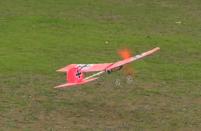
For my first foray into electric flight, I tried a GWS Pico Stick.
This little plane weighs about 5 oz with radio and a small (150mAh
Ni-Cd) battery, and it took me an evening plus a few hours the next day
to assemble it.
 The guy at the
hobby shop warned me that the plane was sensitive to
wind and I shouldn't fly if it was too windy. (He also
recommended the Slow Stick, but I've always liked little planes so I
went for the smaller Pico Stick anyway.)
The guy at the
hobby shop warned me that the plane was sensitive to
wind and I shouldn't fly if it was too windy. (He also
recommended the Slow Stick, but I've always liked little planes so I
went for the smaller Pico Stick anyway.)
Naturally, it turns out it's always windy at Rancho San Antonio.
(Admittedly, we more or less knew this -- we hike there all the
time.) But there I was with my brand new plane and radio gear,
and a little wind didn't scare me.
First step: get the pin for the frequency. (The RSA crew, like
many model airplane clubs, use labelled clothespins for frequency
control. You take the pin corresponding with the channel your
radio uses, to establish that you and only you are using that
frequency; you don't ever turn on your radio if you haven't first
gotten the pin.) The "20" pin isn't up on the top of the board
where the active fliers are, so it's not being used. Whew!
So we look behind the board to find the right pin ... 17, 18, 19,
21, 22 ... hmm. While we're puzzling over what to do, someone
comes over and asks what we're looking for, and we tell him 20, and he
points to the notice on the front of the board: No channel 20.
Turns out the store sold me a radio in the one channel that interferes
with everything. There's some interaction with television channel
4 and various other popular frequencies, which makes channel 20
verboten. In a dark mood, we pack the equipment back into the car
and go for a hike.
After the hike, I went back to the store and talked them into giving me
crystals for another frequency, and the next morning we go back to
RSA. This time things work outed, I grabbed the pin and we were
off.
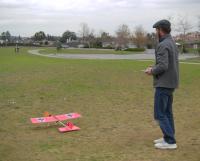 (This picture
shows Dave with the plane, though I was flying, that first day.
Dave professed disinterest in
trying it -- that lasted about two days. Unfortunately, Dave forgot his
camera,
so we have no pictures yet of me flying it; pictures on this page
are some that I took a few days later, after Dave decided maybe it
might
be fun to try flying after all.)
(This picture
shows Dave with the plane, though I was flying, that first day.
Dave professed disinterest in
trying it -- that lasted about two days. Unfortunately, Dave forgot his
camera,
so we have no pictures yet of me flying it; pictures on this page
are some that I took a few days later, after Dave decided maybe it
might
be fun to try flying after all.)
Building:
I built the Pico Stick in an evening plus an hour or so the next
day. The instructions are mostly fairly clear. I was
surprised that the instructions called for drilling, on such a simple
model; but it turned out "drill a hole" mostly meant through foam, so I
didn't even need the drill, just a small drill bit (and if I hadn't had
a drill bit I probably could have made do with a piece of wire or
something). Also, the instructions call for epoxy and CA glue as
well as the supplied GWS glue.
The only problem I had was with the receiver mount: the receiver sticks
to the mount with double-stick tape, but then the plastic mount is
supposed to be glued to the stick. Sounds fine, but I tried this
first with the supplied GWS glue, and it fell off on the second flight;
then I tried with epoxy, but that didn't stick either. I ended up
using a grocery bag wire tie to hold the receiver onto the stick.
A note about the GWS glue: I learned from web searches after the Pico
Stick was all built that it isn't actually glue at all -- it's contact
cement, and you're supposed to apply it to one side, match the two
sides, then separate them and let the cement dry until it's tacky
before reassembling. The instructions say nothing about how to
use the glue or what it is.
Flying:
As advertised, the Pico Stick is very sensitive to wind. The
little motor is so underpowered that in a moderate wind, it really
can't make any headway -- it nearly flies backward. This is
interesting, but it makes flying challenging since if you want to fly
circles, you run the risk of not being able to fly back to the landing
area. I lost the Pico in the weeds downwind of the flying field
quite a few times due to this.
The turning response is very slow. It has only a rudder, no
ailerons, but it has very little dihedral. It took a while for me
to get used to the idea that giving it right or left stick meant
"sometime in the next five or ten seconds, think about maybe starting a
lazy turn in that direction." On the first few flights, I tried
to turn, found it didn't respond, and gave up to try to turn the other
way. With the Pico Stick you have to be very patient, hold the
control input and wait ... eventually it will respond.
Elevator is more sensitive -- I had no problem getting it to climb or
descend on command, and there wasn't much delay.
Crashing:
On the plus side, the incredibly light weight (around 5 oz fully
equipped with radio and battery) means that it's very difficult to hurt
it in a crash. Even when I lost all control and the plane spun in
from
fairly high off the ground, it hit with no damage.
On the other hand, Dave found some more creative ways of crashing
it. Flying nose-first into the ground with throttle still on most
of the time just shakes the wings loose (push the dowels back into
their holders and it's good to go for another flight) but after a few
of those, I discovered that the plastic battery holder had
broken. That didn't affect the Pico's flying ability, but it did
make battery changes more difficult since the rubber bands had to
stretch around the stick body, and tended to slip out. Eventually
I pulled the whole thing off and built my own (see below).
 As a
trainer:
As a
trainer:
As someone who's flown in the past, but is very rusty, I didn't have
much trouble adjusting to the Pico Stick. I found it a bit boring
to fly, but good practice for me in being smooth and a good vehicle for
practicing touch-and-goes while I worked up the nerve to try my next
plane, a 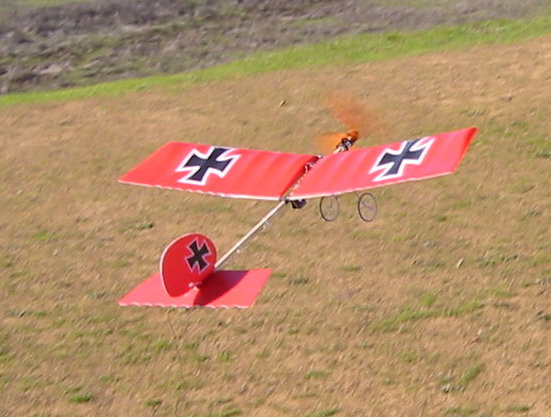 The guy at the
hobby shop warned me that the plane was sensitive to
wind and I shouldn't fly if it was too windy. (He also
recommended the Slow Stick, but I've always liked little planes so I
went for the smaller Pico Stick anyway.)
The guy at the
hobby shop warned me that the plane was sensitive to
wind and I shouldn't fly if it was too windy. (He also
recommended the Slow Stick, but I've always liked little planes so I
went for the smaller Pico Stick anyway.)